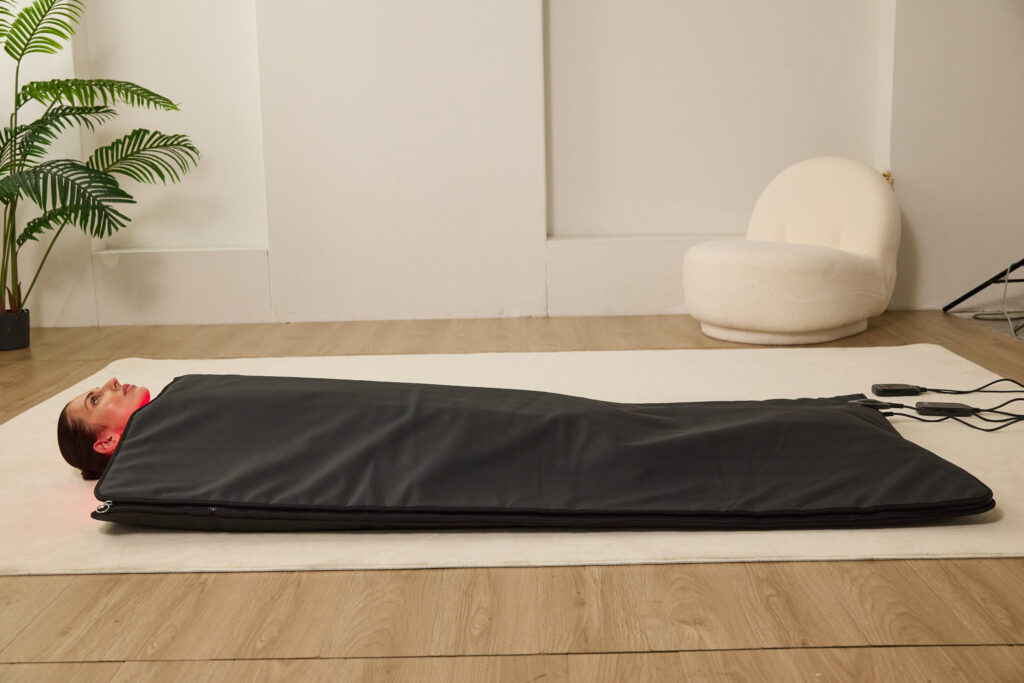
A sauna blanket is a portable wrap that you can heat up electrically and wrap around most of your body for a controlled heat session while keeping your head out.
An infrared sauna blanket uses heated materials that emit far-infrared radiation, combined with an insulated enclosure, to deliver warmth close to the body. It fits into spaces where a permanent sauna cabin would be impractical: a home relaxation area, a spa treatment room, or a compact wellness studio.
For private label brands, the appeal is equally practical. A blanket offers a relatively compact product format with opportunities to customize its appearance, controls, packaging, and user experience.
But two blankets that look similar can behave differently. Heating layout, lining materials, temperature sensing, and electrical protection all affect the finished product. Understanding those details makes it easier to choose a blanket—or source one for your own brand.
What Is an Infrared Sauna Blanket?
Think of a sleeping-bag-style enclosure with an integrated heating system, a controller, and an easy-access closure. Depending on the design, a zipper or hook-and-loop fastening secures the blanket around the user.
Unlike a traditional wooden sauna, the blanket does not need to heat an entire room. Its heating surfaces sit close to the body, while its layers help retain warmth within the enclosure.
That changes the practical requirements.
| Buying Consideration | Far-Infrared Sauna Blanket | Traditional Wooden Sauna |
| Space | Requires a suitable surface during use; can usually be stored afterward | Requires a dedicated cabin or installed space |
| Portability | Can be moved when cool and packed according to instructions | Usually remains in a fixed location |
| Heating approach | Heated flexible surfaces surround much of the body | A heater warms the cabin and its occupants |
| Energy use | Generally has a lower electrical power requirement than a full-size electric cabin | Depends on heater size, cabin volume, insulation, and operating time |
| Initial investment | Generally lower than purchasing and installing a cabin | Usually includes higher equipment and installation costs |
| Experience | Individual, reclining session with the head outside | Seated or reclining cabin experience, sometimes shared |
| Maintenance | Cleaning and drying the lining, checking cables and closures | Cleaning the cabin and maintaining the heater and interior |
Actual running costs depend on wattage and session length. For example, a hypothetical 600 W appliance operating continuously for 30 minutes would consume 0.3 kWh. That is an illustration—not a FITKANG model specification—and temperature cycling can change actual consumption.
A sauna blanket is a different format, with its own advantages. It should not be presented as providing exactly the same experience or health outcomes as a traditional sauna.
How Does an Infrared Sauna Blanket Work?
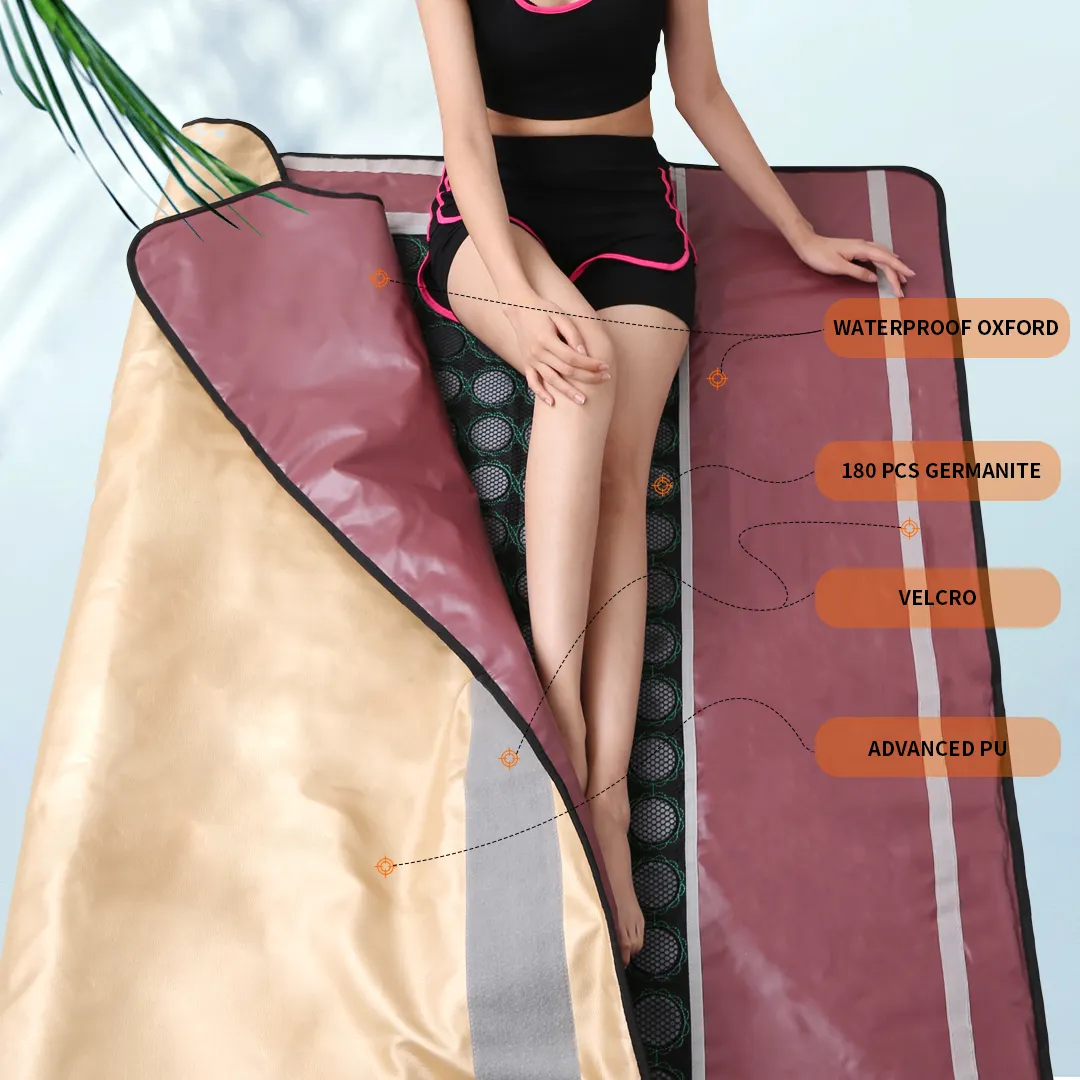
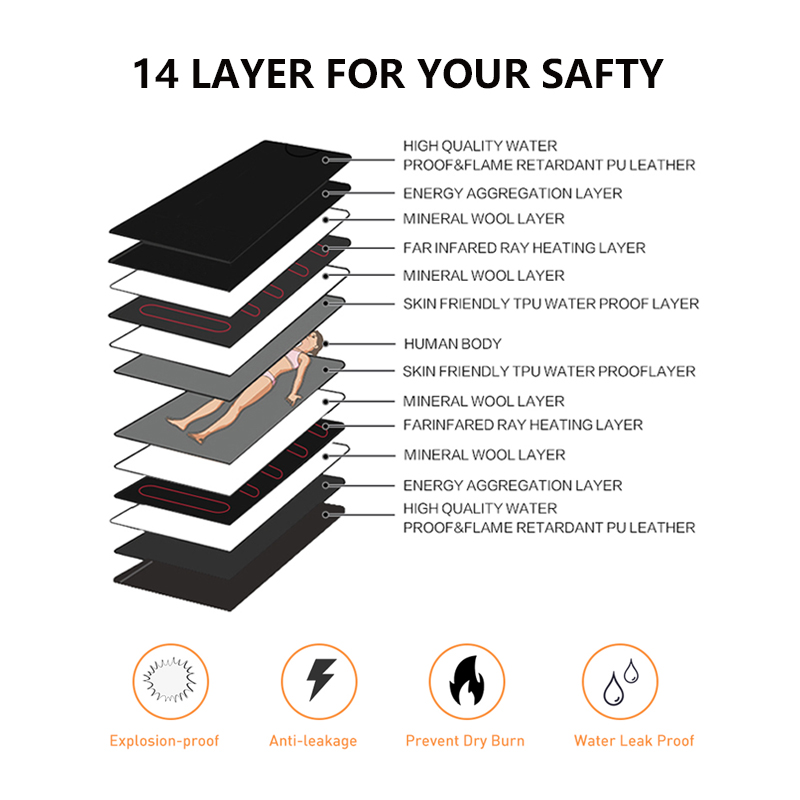
Electricity passes through the blanket’s heating elements, generating heat. The warmed materials emit infrared radiation, while the enclosure reduces heat loss. Contact with the heated lining also contributes to heat transfer.
The controller regulates the heating system according to its sensors and programmed settings. As the body warms, sweating may occur as part of its normal temperature-regulation response.
Heating Elements and the Far-Infrared Spectrum
Far-infrared, or FIR, describes a region of the infrared spectrum. The 8–14 μm band is commonly discussed in thermal wellness products, but it is not the complete definition of FIR. Actual emission depends on material properties and operating temperature; a precise wavelength claim needs measurement.
One distinction matters here: radiation penetration and the spread of warmth are different processes.
Long-wave infrared energy is strongly absorbed near the skin’s surface. A blanket should not be described as sending 8–14 μm radiation directly 1.5–2 inches into tissue. Deeper warming can develop through heat transfer and circulation, rather than deep optical penetration. See the discussion of tissue absorption in Light in diagnosis, therapy and surgery.
Researchers have investigated FIR exposure across several devices and applications. That research provides useful background, but it does not establish that every sauna blanket delivers the same therapeutic effects. The Vatansever and Hamblin review covers a range of FIR technologies, not a clinical validation of a particular consumer blanket.
For buyers, consistent heating and documented controls are more useful than a dramatic penetration claim.
Temperature Controls and Dual-Zone Heating
A single-zone blanket regulates its heating area through one user setting. A dual-zone design allows separate settings for two areas—often the upper and lower body, depending on the model.
Separate settings can improve comfort for users who prefer less warmth around one part of the body. They also introduce additional components that need evaluation: sensors, control channels, wiring, and the boundary between heating zones.
When we discuss a dual-zone specification with a buyer, the useful question is simple: what does each zone actually control? Two numbers on a display are not enough. The zone layout and sensing arrangement should be clear.
A built-in timer ends the programmed session. Overtemperature protection serves a separate purpose: responding to excessive heat or certain fault conditions. Buyers should check both.
Explore our infrared sauna blanket series to compare available configurations and request the specifications for your preferred model.
What Is an Infrared Sauna Blanket Made Of?
Sauna blanket materials influence comfort, cleaning, durability, and electrical insulation. A useful assessment looks at the complete layer structure—not just the outer finish.
Outer Cover and Inner Waterproof Lining
PU-coated fabrics and TPU materials can provide flexible, wipe-clean surfaces. PVC-coated materials also appear in this product category, with quality varying by formulation and construction.
The material name alone does not establish safety.
A well-specified PU or TPU surface should be evaluated for repeated heat exposure, flexing, moisture, seam durability, and compatibility with the intended cleaning products. The same scrutiny applies to PVC. “Premium,” “non-toxic,” and “zero odor” are claims that need defined evidence.
| Material Check | What a Buyer Should Request |
| Composition | Identification of the coating, backing fabric, and relevant additives |
| Heat resistance | Evidence appropriate to the model’s intended operating conditions |
| Odor | Sample evaluation during initial and repeated heating |
| Chemical restrictions | Test documentation relevant to the destination market |
| Cleaning compatibility | Approved cleaners, methods, and any disinfectant limitations |
| Durability | Evaluation of seams, folds, surface adhesion, and closures |
A lack of odor is desirable, but it does not prove chemical safety. A water-resistant lining also does not make the controller, connectors, or entire blanket washable.
For spa buyers, cleaning compatibility deserves particular attention. A surface that looks good when new may perform differently after repeated exposure to sweat and disinfectants.
Carbon Fiber Heating Elements and Low-EMF Design
Carbon-based heating elements can be incorporated into flexible blankets. Metallic resistance elements are another approach. Both generate heat through electrical resistance; performance depends on how the complete system is designed.
Even heating comes from a combination of element spacing, power distribution, insulation, sensor placement, and control response. Carbon fiber alone does not guarantee uniformity or eliminate hot spots.
It also does not automatically mean zero electromagnetic fields. A non-magnetic material can still carry electrical current, and the assembled product includes wiring, a power connection, and a controller.
For any low-EMF claim, request a report identifying:
- The model and controller tested.
- Whether electric fields, magnetic fields, or both were measured.
- Measurement distance and positions.
- Operating settings and electrical supply conditions.
- Instruments and units used.
From a sourcing perspective, the report should describe the product you intend to buy. A reading taken far from a different model tells you little about the actual user position.
What Is It Like to Use an Infrared Sauna Blanket?
A good session starts with the instructions for the specific model. Preheating time, clothing requirements, temperature settings, and permitted surfaces can differ.
Prepare the space. Place the blanket on a flat, dry surface approved by the manufacturer. Unfold it fully and check the lining, cable, and connector for damage. Keep the controller clear of the heated enclosure.
Choose the recommended clothing or liner. Some models call for loose cotton clothing and socks; others specify a compatible towel insert or liner. Follow those requirements rather than using bare skin by default.
Use disposable liners only when approved for the particular blanket and temperature range. An improvised plastic bag can change heat transfer and moisture retention. A liner marketed as a “detox bag” is not evidence of detoxification.
Preheat and select the session settings. If preheating is required, follow the prescribed setup. Start with the manufacturer’s beginner guidance. A higher setting is not automatically more effective.
Stay awake and pay attention. Keep the head outside and make sure the closure is easy to release. Stop if you feel dizzy, nauseated, unusually weak, or uncomfortably hot. Do not use the blanket while sleeping or after drinking alcohol. People who are pregnant, have reduced heat sensation, or have conditions or medications affecting heat tolerance should seek medical guidance before use.
Cool, clean, and store. Switch off and unplug the unit. Once it has cooled, remove the liner and clean the approved surfaces. Let everything dry before storing it with gentle folds or a loose roll, as directed. Avoid sharp creases and heavy objects on top.
For commercial operators, build cooling and cleaning time into the booking schedule. The session does not end when the timer stops.
What Should You Check Before Sourcing or Buying One?
Start with the intended user and setting. A home-use private label product and a blanket intended for repeated spa sessions may need different documentation, maintenance arrangements, and durability checks.
| Check | Why It Matters | What to Verify |
| Size and fit | Determines usable space and comfort | Internal dimensions, closure adjustment, and maximum recommended user size |
| Rated power | Affects electrical demand and heating behavior | Wattage on the rating label; avoid treating higher power as inherently better |
| Voltage and plug | Must match the destination market | Exact voltage, frequency, plug, and controller configuration |
| Heating controls | Determines how the user manages warmth | Zone layout, sensor arrangement, timer, and display meaning |
| Overheat protection | Addresses excessive temperature and faults | Protection design and relevant test results |
| Low-EMF claims | Needs measurable support | Model-specific test conditions and results |
| Cleaning | Affects daily use and commercial turnaround | Approved products and methods |
| Service support | Matters after delivery | Warranty, spare controllers, replacement parts, and fault-handling process |
A display temperature is not necessarily a measurement of skin temperature. Ask what the controller measures and where the sensor sits.
For private label projects, define these points before artwork and packaging are finalized. Our OEM/ODM custom sauna solutions provide a starting point for discussing the product configuration, branding, and target market.
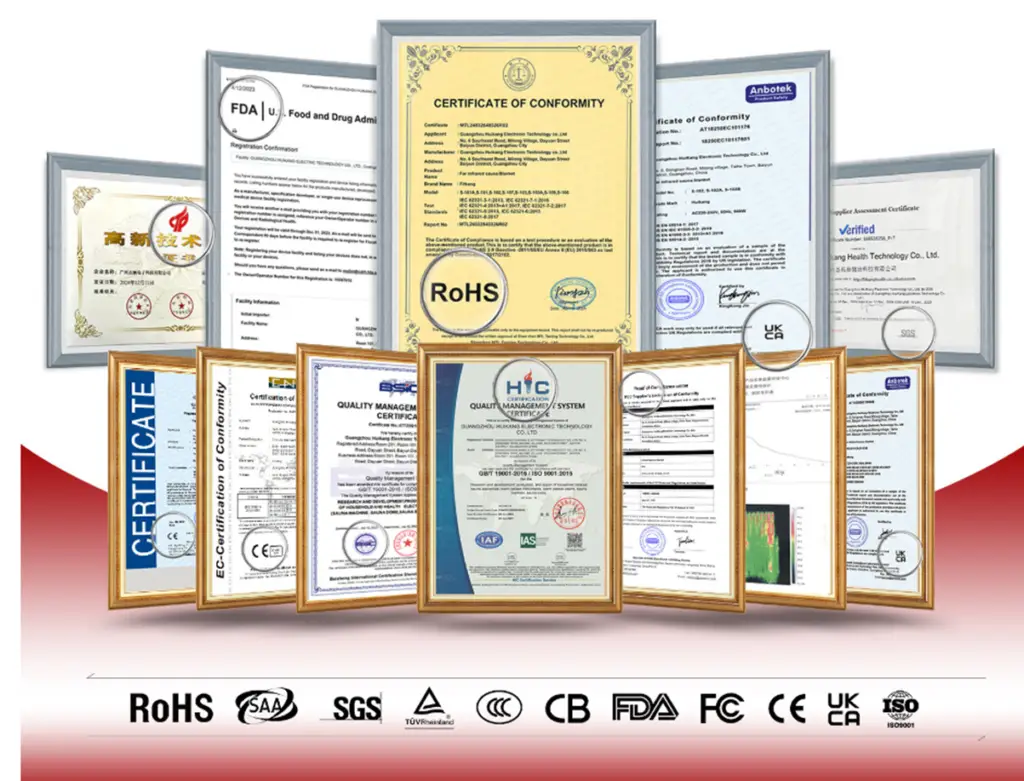
Certification claims also need precision. CE, RoHS, FCC, and ETL are not interchangeable evidence, and their relevance depends on the product and market. Ask for the applicable declarations, reports, and listings that identify the actual blanket and controller.
For flexible heating appliances, IEC 60335-2-17 is a relevant standard to discuss with a qualified testing laboratory, alongside IEC 60335-1. The laboratory should confirm the correct scope and national requirements for the intended product. IEC’s scope description includes flexible appliances and their supplied controllers.
If FDA status is mentioned, distinguish registration or listing from authorization to market a device for a particular intended use. The FDA explicitly states that establishment registration and device listing do not mean approval or clearance.
FITKANG: Your OEM/ODM Infrared Sauna Blanket Manufacturing Partner
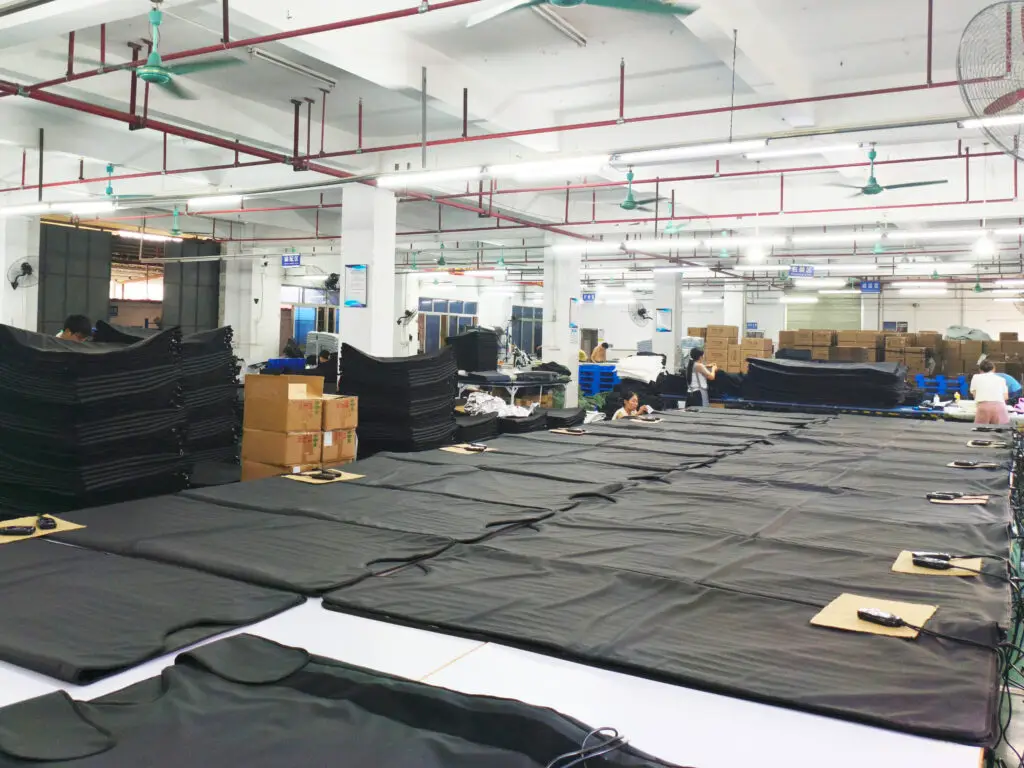
FITKANG works with brand owners, importers, Amazon sellers, and wellness distributors on far-infrared sauna blanket manufacturing and customization.
Our starting point is the product brief: who will use the blanket, where it will be sold, and which features the brand needs to support. Those decisions shape the materials, heating system, controller, labeling, and packaging.
Private Label Branding and Product Customization
Project discussions can cover logo printing, outer appearance, retail gift boxes, instruction manuals, carrying accessories, and controller options.
For buyers planning an initial order of 50–100 units, ask us to assess an existing model with basic branding first. The final MOQ depends on the selected platform and customization scope. Custom colors, new tooling, and controller development may require different quantities and lead times.
An approved sample should record more than the logo position. Confirm materials, dimensions, heating configuration, controller behavior, accessories, and packaging before releasing the production order.
Quality Requirements That Can Be Checked
We encourage buyers to put quality expectations into the specification.
For PU or TPU materials, that means agreeing on the material grade, supporting test documentation, cleaning compatibility, and odor acceptance criteria. For heating components, it means defining the required durability and functional checks.
If your purchasing requirement includes 100% powered aging tests, specify the conditions, duration, acceptance criteria, and recordkeeping in the order. “Aging tested” is much more useful when everyone understands what the test involves.
The same approach applies to certification. Request the current documents for the selected model and destination market before making claims on packaging or marketplace listings.
ISO 13485 concerns medical-device quality management systems. When assessing a supplier’s certificate, check the legal entity, manufacturing site, scope, and validity. It is not a product safety certificate and does not, by itself, make a sauna blanket a medical device. ISO’s standard overview explains its quality-management purpose.
Planning a private label launch or expanding your wellness product range?
Send FITKANG your target market, estimated order quantity, preferred heating configuration, and branding requirements. Request factory-direct samples, the available model documentation, and a wholesale quotation through FITKANG.
A detailed brief makes the quotation more useful—and the sample easier to evaluate.
Frequently Asked Questions
What Main Types of Far-Infrared Sauna Products Does FITKANG Offer?
FITKANG’s sauna range includes far-infrared sauna blankets and sauna domes. This guide focuses on blankets, including the single-zone and multi-zone configurations available for particular projects. Request the current catalog to confirm model availability.
Is an Infrared Sauna Blanket the Same as a Standard Electric Heating Blanket?
No. A standard electric blanket generally provides warmth for bedding or comfort, while a sauna blanket is designed for a timed, enclosed heat session.
The enclosure, surface materials, operating instructions, and control requirements differ. Do not use an ordinary electric blanket to improvise a sauna enclosure.
What Is the Optimal Temperature and Session Time?
There is no single optimal setting for every blanket or user. Follow the specific model’s instructions, including its beginner settings and maximum session duration.
Do not treat the controller’s maximum temperature as a recommended target. Research has not established one universal sauna schedule for all users or intended outcomes; the systematic review by Hussain and Cohen identifies this as an area needing further study.
How Do You Clean and Sanitize an Infrared Sauna Blanket?
Switch it off, unplug it, and allow it to cool. Remove sweat and residue with the manufacturer-approved cleaning method.
For shared use, follow a validated disinfection procedure, including the disinfectant’s contact time and compatibility with the lining. Cleaning and disinfection are separate steps.
Do not immerse the blanket, spray liquid into connections, or store it damp. A waterproof surface does not mean the entire appliance can be washed.
What Sauna Blanket Safety Features Should Buyers Look For?
Look for temperature control, a session timer, overtemperature protection, sound electrical insulation, durable connections, and an enclosure that the user can exit easily.
Low-EMF claims should have clear measurement evidence. They do not replace electrical and thermal safety testing.
Also check the instructions: a product with unclear operating limits is harder to use and support responsibly.
Do You Support Custom Logos, Control Boxes, and Low-MOQ Private Label Orders?
FITKANG can discuss logo printing, packaging, and controller customization as part of an OEM/ODM project.
Basic branding on an existing model is usually simpler than developing a new control box or changing the heating architecture. If your launch target is 50–100 units, provide the required customization list so we can confirm whether that quantity is workable and quote the appropriate option.
Scientific References & Industry Standards
These sources explain the research background and relevant standards. They do not certify FITKANG products or establish medical benefits for a particular sauna blanket.
1. Vatansever F, Hamblin MR. Far infrared radiation (FIR): its biological effects and medical applications. Photonics & Lasers in Medicine. 2012. DOI: 10.1515/plm-2012-0034. A review of FIR technologies and biological research across different applications. Read on PubMed
2. Hussain J, Cohen M. Clinical Effects of Regular Dry Sauna Bathing: A Systematic Review. Evidence-Based Complementary and Alternative Medicine. 2018;2018:1857413. DOI: 10.1155/2018/1857413. Reviews sauna research and its limitations; it does not establish equivalent results for consumer sauna blankets. Read on PubMed
3. IEC 60335-2-17:2022. Household and similar electrical appliances—Safety—Part 2-17: Particular requirements for blankets, pads, clothing and similar flexible heating appliances. Consult a qualified laboratory about applicability, use with IEC 60335-1, and destination-market requirements. View the IEC standard
4. ISO 13485:2016. Medical devices—Quality management systems—Requirements for regulatory purposes. Addresses quality management systems; product certification and market authorization require separate assessment. View the ISO standard