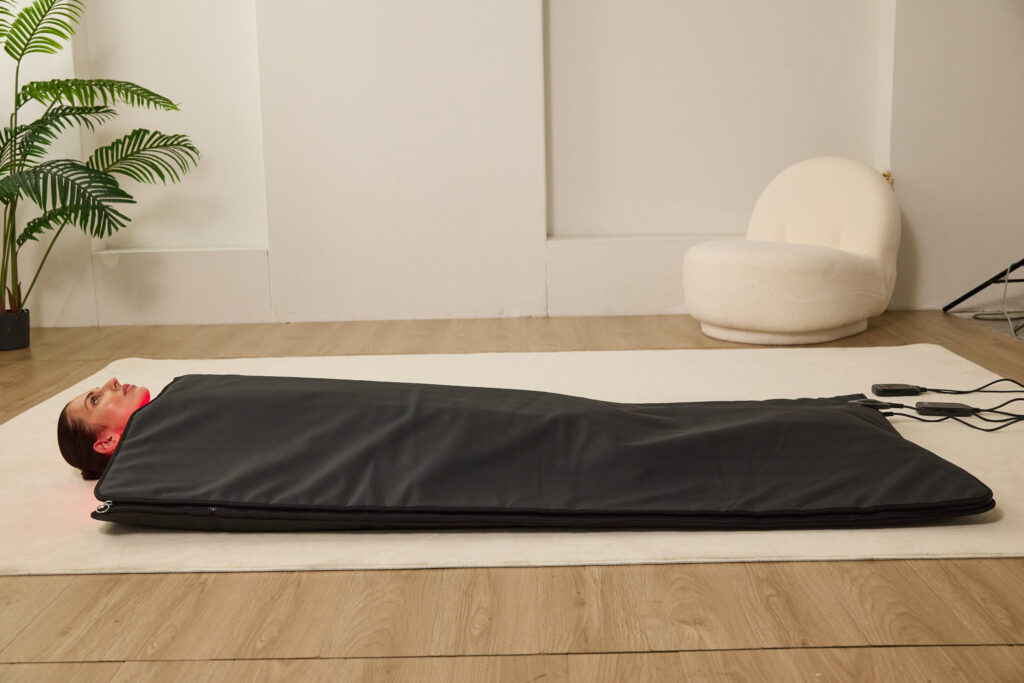
A low EMF sauna blanket should come with more than a reassuring label. The useful questions are how its heating circuit is arranged, what fields have been measured, and whether its electrical, thermal and material safety claims are supported for the exact model you plan to buy.
Because a sauna blanket operates close to the body, buyers reasonably want clear information about its heating elements and protective layers. Low magnetic-field readings are one part of product evaluation, not a substitute for burn prevention, insulation, moisture protection or correct use. This guide explains the engineering choices and the evidence that home users, retailers and OEM buyers should request.
Explore engineered low-EMF heating configurations in our Infrared Sauna Blanket Series.
What EMF Means in an Infrared Sauna Blanket
Electric heating appliances produce electric and magnetic fields. Voltage creates an electric field; current flowing through conductors creates a magnetic field. For mains-powered equipment, 50 or 60 Hz is an important frequency, while electronic controllers and power supplies can introduce other frequency components. [1]
Infrared heat is also electromagnetic energy, but it occupies a different frequency range from power-frequency fields. In product marketing, “low EMF infrared sauna blanket” usually refers to reducing unwanted fields associated with the electrical system, not eliminating the infrared energy used for heating.
Keep the quantities separate when reviewing a specification:
- Magnetic flux density: commonly reported in milligauss (mG) or microtesla (µT). One µT equals 10 mG.
- Electric-field strength: normally reported in volts per metre (V/m).
- Frequency and operating conditions: essential context for interpreting either measurement.
A magnetic-field reading alone cannot describe electric-field exposure, electrical leakage, surface temperature or overall sauna blanket safety. A lower number also does not, by itself, establish a clinical benefit.
How Low EMF Infrared Sauna Blankets Are Engineered
Heating line architecture and field cancellation
One engineering approach places outgoing and return current paths close together. When equal currents flow in opposite directions, their magnetic fields can partially cancel outside the pair. Reducing the area enclosed by the circuit helps limit the field it produces.
Bifilar or double-helix arrangements can implement this principle, but the name alone proves little. The conductors must actually form the intended opposing-current paths. Wire spacing, routing, connections and the distance to the user all influence the result. A poorly routed power lead can remain a local source even if the main heating area performs well.
Carbon fiber is a heating material, not an automatic low EMF guarantee. A carbon-fiber circuit still carries current. Evaluate the complete layout and assembled product rather than assuming that a particular fiber, wire shape or “cancellation technology” label establishes performance.
For an OEM project, ask for construction details, a measurement map across the heating area and results around cable entries and the controller. Compare models under equivalent operating conditions.
Insulation and shielding serve different purposes
Electrical insulation separates live parts from accessible surfaces. Its performance depends on the material, thickness, seams, assembly and resistance to heat, moisture and repeated flexing. A layer count alone is not an insulation rating.
Infrared sauna blanket shielding addresses a different problem. A conductive layer, such as aluminum foil, may help control electric fields when properly integrated into the electrical design. Thin aluminum foil should not be treated as an effective general shield against 50 or 60 Hz magnetic fields. Low-frequency magnetic-field reduction usually requires attention to current routing or specialized magnetic shielding, with verification on the finished assembly. [1]
The foil may also have a thermal function. A heat-spreading layer is not automatically a validated electromagnetic shield. Ask which field and frequency range it addresses and how the claim was tested.
Any conductive layer must remain safely separated from live conductors. Where a design uses protective earthing, its continuity and fault protection need verification; double-insulated designs use a different protective approach. Users should never add foil, modify grounding or attach improvised shielding to a blanket.
Temperature sensing and power control
An NTC thermistor changes resistance with temperature. Used as a sensor, it supplies feedback to a controller that adjusts heating power. Sensor placement, calibration, response time and fault detection determine how useful that feedback is. [2]
An NTC temperature sensor is not, by itself, a current-spike suppressor or voltage regulator. Dedicated NTC inrush limiters also exist, but they are selected and connected for a different function. [3] Overcurrent protection, supply regulation and surge protection must be evaluated separately.
Electronic switching can introduce harmonics and electrical noise. Circuit layout, filtering and switching strategy may help manage these effects, but “smart control” does not establish low-field performance. Testing should capture relevant warm-up, steady-heating and cycling conditions, including the different zone configurations where applicable.
A low-voltage blanket is not automatically low magnetic field either. At a given power, reducing voltage can require more current. The power supply, cable arrangement and heating circuit still matter.
Beyond EMF the Other Safety Layers That Matter
Materials need evidence beyond a premium label
PU leather can provide a flexible, wipe-clean surface. Insulating textiles and flame-retardant layers may help manage heat and ignition risk. However, “high-grade PU,” “eco-friendly” and “flame-retardant cotton” describe intended properties; they do not establish the safety of every finished product.
If you are searching for a non-toxic sauna blanket material, ask which substances or emissions were tested, which limits were applied and whether the sample represents the finished blanket. Coatings, adhesives, pigments and internal layers can all matter, especially in a heated assembly.
Do not treat “zero VOC” as a blanket guarantee of chemical safety. VOC definitions and test conditions differ. EPA notes that some products labeled low VOC or no VOC under air-pollution rules can still contain toxic volatile chemicals. [4] Low odor is also not a substitute for emissions or substance testing.
For procurement, request relevant restricted-substance documentation and, where claimed, emissions results with temperature, conditioning, test method and detection limits. Flame resistance should be supported by an identified test and does not mean that the product cannot burn.
Thermal protection should cover foreseeable faults
Reliable temperature regulation is important, but it should not carry the entire safety function. Evaluate protection against faults such as a failed sensor, a stuck switching component or localized heat accumulation.
- Temperature sensors should monitor locations relevant to the heating design, with appropriate responses to sensor faults.
- An independent thermal cutoff or other validated protective arrangement should address abnormal overheating.
- An automatic timer limits session duration; it does not replace temperature protection.
- Overcurrent protection addresses excessive current. A localized hot spot may occur without enough total current to trip a fuse.
Ask how the assembled product behaves during relevant abnormal-operation tests, not simply whether it contains a sensor and timer. Electrical checks can include insulation resistance, dielectric strength and leakage or touch current, with protective-earth tests where the design requires them.
Even a well-protected blanket must be used as instructed. Do not operate it folded, compressed or damaged, and do not use higher settings to compensate for a fault. A low EMF claim does not override precautions for heat exposure or the manufacturer’s user restrictions.
Moisture resistance must include seams and connections
Sweat creates a demanding environment for flexible electrical products. A suitable internal barrier can help keep moisture away from heating elements and connections. Its performance depends on sealed edges, cable-entry construction and resistance to flexing, cleaning and thermal cycling.
Waterproof surface material does not make the controller, plug or complete blanket waterproof. If an ingress-protection rating is claimed, confirm which component it covers and the conditions of the test. Avoid interpreting “sweat-resistant” as permission to immerse or machine-wash the product.
Request evidence for moisture resistance and durability that reflects the intended use. Follow the cleaning instructions, keep electrical connections dry and stop using the blanket if the lining, seams, cables or connectors are damaged.
Understanding Safety Markings and Test Reports
CE marking and RoHS compliance
CE marking indicates the manufacturer’s declaration that the product meets applicable EU requirements. It is not a general approval issued by the EU or proof that an independent body has certified every safety claim. [5] Ask for the EU Declaration of Conformity, the matching model designation and the supporting reports for the applicable legislation.
RoHS restricts specified hazardous substances in electrical and electronic equipment within its scope. [6] It does not establish low EMF performance, low VOC emissions, skin compatibility or thermal safety. A collection of logos without model-specific documents is not enough.
FCC documentation has a different scope
FCC equipment authorization addresses applicable US radiofrequency requirements, including interference controls. [7] Its relevance and authorization route depend on the electronics and radio functions in the product.
An FCC claim is not a substitute for electrical or fire-safety evaluation, and it does not establish a low 50 or 60 Hz magnetic-field reading. Ask what rule, equipment configuration and report the claim refers to rather than assuming all FCC documentation has the same meaning.
Product safety standards and independent EMF testing
IEC 60335-2-17 covers particular safety requirements for blankets, pads, clothing and similar flexible heating appliances. IEC 62233 addresses measurement of electromagnetic fields from household and similar appliances in relation to human exposure. [8, 9] A qualified laboratory should determine the appropriate classification, standards, editions and national requirements for the actual product and intended market.
These standards serve different purposes. Passing an emissions or exposure assessment does not replace the rest of the electrical and thermal evaluation. Likewise, a test of one controller, cable length or supply version should not automatically be extended to a modified model.
Prefer reports from a competent independent laboratory, with relevant ISO/IEC 17025 accreditation where available. Check the laboratory’s accreditation scope as well as the report number, date, sample identification and complete results. Accreditation demonstrates competence for the listed activities; it is not certification of every product the laboratory encounters.
Read the measurement conditions before the headline number
A useful low EMF report should identify:
- Exact model, heating zones, controller, power supply and supply voltage or frequency.
- Field type, units and frequency range covered by the instrument.
- Probe type, calibration, measurement uncertainty and detection limits.
- Measurement positions and distance from the heating surface, cables and controller.
- Operating modes, heat settings, warm-up or cycling state and background conditions.
- Whether reported values are RMS, peak, maximum across locations or another defined metric.
- The assessment method and applicable limit or comparison criterion.
A reading taken away from the blanket cannot be presented as a contact-surface result. A displayed zero may only mean the signal falls below the instrument’s resolution. Comparing measurements made with different distances, frequency bands or operating modes can be misleading.
Why zero EMF and ultra low EMF need careful wording
“Zero EMF” is too broad for an electrically heated infrared product. Even “ultra-low EMF” is not a substitute for a defined test result. There is no single marketing number in mG that describes every frequency, field component and product configuration.
Published exposure guidance is frequency-dependent, and assessment may need to account for more than one frequency component. [10] Avoid inventing a universal pass limit or describing a result as “WHO certified.” A precise claim identifies the measured field, value, distance, operating conditions and supporting report.
Low-field results do not establish suitability for a person with an implanted electronic device. Follow both the blanket and implant manufacturers’ instructions and obtain appropriate clinical guidance before use. [11]
Buyer Checklist for a Low EMF Sauna Blanket
Use these questions before buying a home unit or approving an OEM specification. For distributors, retain the answers with the exact configuration ordered.
- Heating circuit: What current-routing method reduces fields, and is the assembled blanket tested rather than only a wire sample?
- Measured performance: Are magnetic and electric fields distinguished, with units, distance, frequency range and operating mode stated?
- Shielding and insulation: What does each layer do, and how are conductive layers safely isolated or earthed where applicable?
- Heat protection: What happens if a sensor or switching component fails? Is the protective response independently evaluated?
- Materials: Are substance and emissions claims tied to named tests, limits and representative samples?
- Moisture and wear: Are seams, cable entries, repeated folding and cleaning addressed in the durability evidence?
- Compliance: Do declarations, reports and any certification listings match the model, controller, voltage version and target market?
- Use and support: Are clear instructions, restrictions, cleaning guidance, warranty terms and service contacts available?
For custom projects, confirm whether changes to size, heating zones, insulation, shielding, cables or controllers require additional assessment. Keep an approved bill of materials and a change-control process so production stays aligned with the tested design.
Choose Documented Engineering and Clear Specifications
A well-evaluated low EMF sauna blanket combines deliberate electrical design with reliable temperature control, suitable materials and protection against moisture and mechanical wear. Confidence should come from traceable test results and practical instructions, not a zero-EMF promise or a list of certification logos.
For home users, compare complete safety information before choosing a model. For brands and distributors, request the relevant reports early and confirm that your custom configuration is covered before approving production.
Explore FITKANG Sauna’s infrared sauna blankets and ask our team about documented product specifications and custom OEM options. Discuss your target market, heating configuration and required testing so the selected product can be evaluated against your purchasing requirements.
References
[1] WHO — Exposure to extremely low frequency fields
[2] TDK — NTC thermistors for temperature measurement
[3] TDK — NTC inrush current limiters
[4] US EPA — VOC claims in household products
[5] European Commission — CE marking
[6] European Commission — RoHS Directive
[7] FCC — Equipment authorization and its scope
[8] IEC — IEC 60335-2-17 amendment and standard family
[9] IEC — IEC 62233 household appliance EMF measurement
[10] ICNIRP — Low frequency fields and exposure guidance
[11] WHO — Electromagnetic fields questions and answers