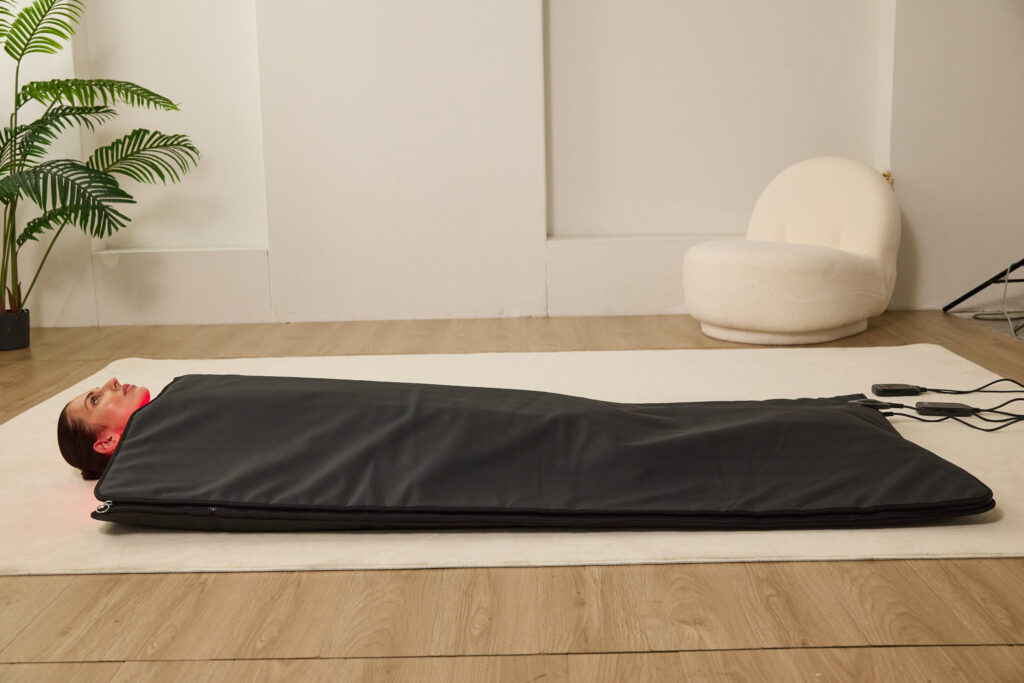
Do sauna blankets work? They can warm the body and produce a noticeable sweating session in a compact, portable format. That is a real effect. The leap from “I got hot and sweated” to “I burned fat, removed toxins, or received a medically proven treatment” is where marketing often outruns evidence. This guide separates what the equipment does from what a seller might imply. It also shows what to ask before buying a heated product that will sit close to your skin.

Myth 1: “A Sauna Blanket Is Just a Big Heating Pad”
Fact: Both devices use electricity to create heat. A heating pad usually warms a limited area through contact. A sauna blanket surrounds much more of the body, retains warmth around the user, and is designed for a timed whole-body heat session. That difference in coverage and use is meaningful. It does not mean a blanket has a unique ability to send far-infrared energy deep into muscle.
Warm surfaces emit infrared radiation, and a blanket also transfers heat by contact and through the warm air trapped inside. The balance depends on its heating element, lining, fit, and operating temperature. Infrared energy at far-infrared wavelengths is strongly absorbed near the skin surface; deeper warming can occur as heat moves through tissue and blood flow changes. A fixed claim such as “penetrates two inches” is not a reliable product specification without a controlled test for the exact device and conditions.
For an electric blanket vs sauna blanket comparison, ask what the product is designed to do. An electric bed blanket is made for bed warming under its stated instructions. A sauna blanket is made for an awake, supervised heat session, usually with a controller, timer, and wipe-clean interior. Never substitute one product for the other or sleep in a sauna blanket unless its own instructions expressly permit it. The relevant electrical safety standard for flexible appliances that heat the body is IEC 60335-2-17; compliance must be checked for the specific model and market.
Myth 2: “One Session Causes Instant, Permanent Weight Loss”
Fact: The scale can drop after a sweaty session because the body has lost water. Drinking and eating normally will restore much of that weight. Sweating is not evidence of fat loss, and a sauna blanket should not be sold as a shortcut to lasting weight reduction.
Heat exposure may raise heart rate and change circulation while you are warm. Those are normal physiological responses to heat, not proof that a passive session burns calories like exercise. Research on traditional or cabin-style saunas also should not be automatically transferred to a close-fitting sauna blanket: heat delivery, body position, exposure, and dose differ. If a seller quotes a precise “calories burned” number, ask for a controlled study of that model and a clear comparison with resting energy use.
“Detox” deserves the same scrutiny. Sweat mainly helps regulate temperature. The liver and kidneys handle most routine elimination of substances from the body. The U.S. National Center for Complementary and Integrative Health reports that evidence for marketed detox programs, including sauna-based approaches, is limited. A reasonable expectation is warmth, perspiration, and a chance to relax—not toxin removal or a medical result.
Myth 3: “High EMF Radiation Is Unavoidable”
Fact: A powered heating product creates electric and magnetic fields while operating. Wiring layout, paired conductors, return-current routing, shielding, grounding, and controller design can affect measured levels. A double-helix or paired-wire design may reduce the magnetic field when opposing currents run close together. It does not prove that every point on the blanket has “zero EMF.”
The useful question is how much was measured, where, and under what conditions? Request a report for the exact model and voltage. It should identify the test method and instrument, field type, measurement position and distance, operating setting, background reading, and results. Magnetic-field readings are often stated in milligauss or microtesla; electric-field results use different units. A single unexplained “low EMF” number is difficult to compare across products.
IEC 62233 specifies methods for assessing electric and magnetic fields around household appliances, including measurement positions and operating conditions. It is a useful framework for asking better questions. It is not, by itself, a blanket-specific guarantee of zero exposure or a substitute for the complete electrical safety assessment. This is the practical sauna blanket safety truth: look for traceable measurements and model-specific documentation rather than an absolute slogan.
Myth 4: “The Higher the Temperature, the Better the Results”
Fact: More heat can increase discomfort and burn or dehydration risk. It does not establish a better wellness outcome. The number on a controller may be a heater setpoint or sensor reading, not the temperature at every part of your skin. Fit, fabric layers, contact pressure, and session length all change the actual heat dose.
Start at a conservative setting, follow the manual for session duration, and stop if you feel dizzy, nauseated, weak, or excessively hot. Use the recommended clothing or liner if the manufacturer specifies one. Do not use a damaged controller, power cord, or heating surface. People who are pregnant, have impaired heat sensation, cardiovascular disease, or an implanted electronic device should ask a clinician whether heat exposure or the device is appropriate for them.
For buyers, the best evidence is engineering documentation: temperature uniformity results, sensor placement, overheat cutoff behavior, electrical insulation testing, and instructions that match the delivered voltage and plug. A certificate or report should name the model and configuration being sold. Features can change between versions, so a generic factory certificate is not enough.
What Should You Expect? A Buyer’s Checklist
These infrared sauna blanket facts are a better basis for a purchase than dramatic before-and-after claims:
– Realistic effect: A controlled, enclosed heat session may create warmth, sweating, and a sense of relaxation. Individual responses vary.
– Weight claim: Immediate scale changes mostly reflect fluid loss. Rehydrate afterward; do not treat sweat as fat loss.
– Heat claim: Ask whether the displayed temperature is a setpoint, sensor reading, or measured surface temperature, and request the allowed time range.
– Electrical safety: Check the exact model’s voltage, plug, instructions, overheat protection, insulation testing, and applicable third-party documentation.
– EMF claim: Request a measurement report with units, locations, distance, operating setting, and background reading. Treat “zero EMF” as an unsupported absolute claim.
– Construction: Inspect seams, zipper or closure, inner lining, cable strain relief, controller connection, and cleaning instructions. Confirm spare parts and warranty terms before ordering.
Review safety-tested standards and certified specifications in our Infrared Sauna Blanket Series. For a specific FITKANG model, ask the team for its current test reports, measured operating data, and voltage configuration before placing a sample or wholesale order.
The Takeaway
A sauna blanket works as a portable heat device when it delivers stable, controllable warmth and is used according to its instructions. It is not a proven fat-loss machine, detox treatment, or substitute for clinical care. Buy the model whose construction, safety controls, and test documents you can actually verify. FITKANG can provide model-specific specifications and sampling information so you can compare products on evidence instead of promises.