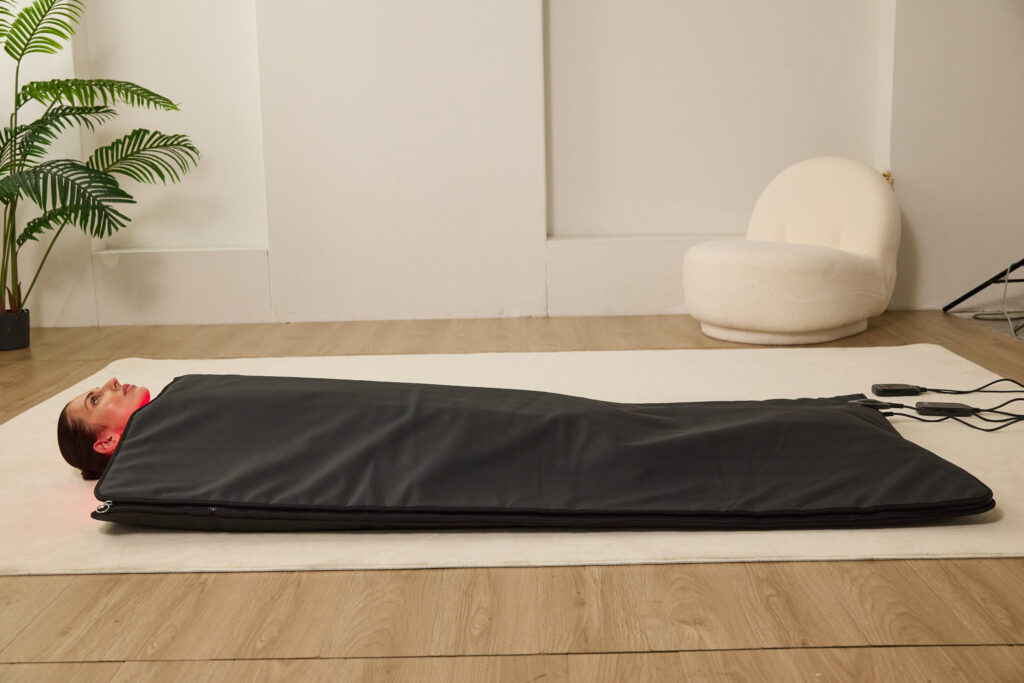
An infrared sauna blanket brings heat close to your body inside a portable wrap. A traditional sauna heats an enclosed room, surrounding you with hot air and radiant warmth from the heater and interior surfaces. Both can make you sweat, but the experience—and the commitment required—differs considerably.
When comparing an infrared sauna blanket vs sauna room, start with practical questions. Where will you use it? Do you enjoy breathing hot air? Will sessions be private or shared? Neither option is universally better. The right purchase depends on your space, budget, heat tolerance, and the routine you will realistically maintain.

The Core Technical Difference: How Heat Is Delivered
Traditional Sauna: Hot Air, Radiant Heat, and Adjustable Humidity
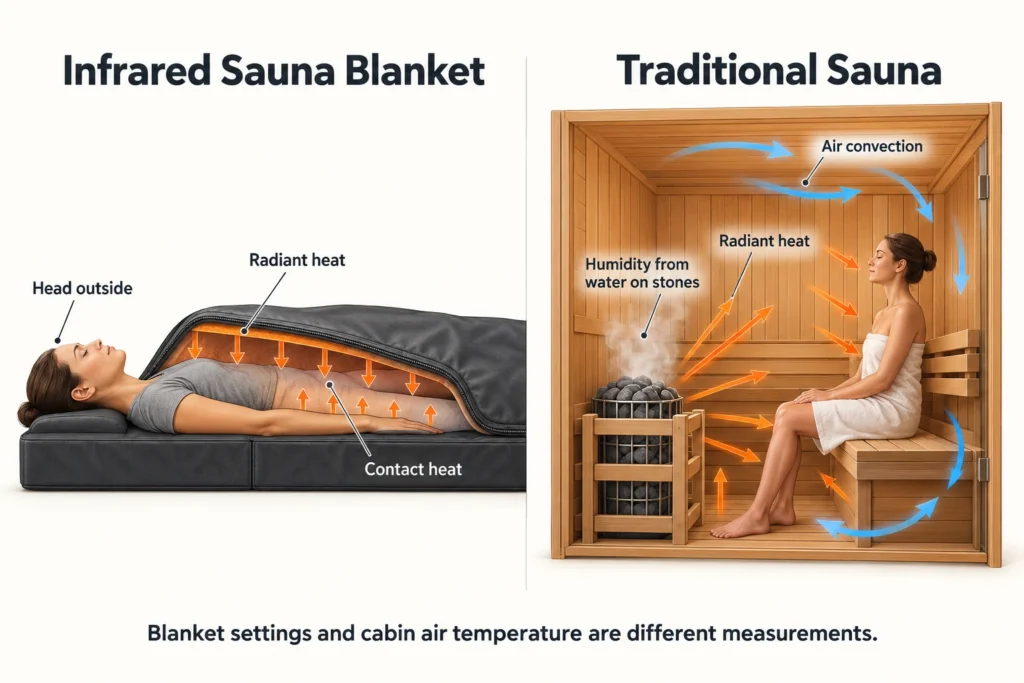
A traditional sauna uses an electric heater or wood-burning stove, typically with heated stones. Air temperatures commonly reach approximately 75–90°C / 167–194°F, although conditions vary with the installation and where temperature is measured.
Heat reaches your body through several routes. Hot air transfers energy by convection, while the stove, stones, and warmed surfaces emit thermal radiation. It is therefore inaccurate to describe traditional saunas as using convection alone.
Pouring water onto approved sauna stones temporarily raises humidity. This reduces the effectiveness of evaporative cooling and makes the heat feel more intense. A traditional sauna with occasional steam bursts is different from a continuously humid steam room.
Infrared Sauna Blanket: Radiant and Contact Heating
A sauna blanket contains electrical heating elements within a flexible enclosure. Warmed materials emit far-infrared radiation, while contact with the lining also transfers heat. Insulation helps retain warmth around the enclosed body.
Some models offer settings around 45–70°C / 113–158°F, with wider ranges available. These are controller settings, not necessarily measured skin temperatures or uniform temperatures throughout the blanket.
That distinction matters. Comparing a blanket set to 60°C with sauna air at 80°C does not directly compare heat exposure. Contact, humidity, insulation, and exposure time all influence thermal strain.
FIR research covers multiple technologies and exposure conditions. It does not establish that every blanket replicates a sauna cabin’s physiological effects. [1]
Head-to-Head Comparison: Sauna Blanket vs. Traditional Sauna
|
Factor |
Infrared Sauna Blanket |
Traditional Sauna |
|
Heat source |
Electrical elements; radiant and contact heat inside an enclosure |
Electric or wood heater; hot air and radiant heat |
|
Operating temperature |
Model-dependent settings; approximately 45–70°C on some products |
Commonly about 75–90°C air temperature |
|
Space required |
A suitable reclining surface during use, plus storage space |
Permanent cabin footprint, clearances, and ventilation |
|
Initial cost |
Several hundred dollars; premium models can exceed $600 |
Several thousand dollars; installed projects can exceed $10,000 |
|
Energy cost |
Usually lower total demand for one user |
Higher heater demand; multiple users can share a session |
|
Setup and portability |
Unfold, connect, and preheat as instructed; portable once cool |
Assembly or construction; electrical work or stove installation |
|
Maintenance |
Clean lining, wash approved inserts, dry before storage |
Clean benches, ventilate, inspect heater and stones |
|
Session experience |
Usually reclining alone, with the head outside |
Full-body ambient heat, more movement, and shared sessions |
Temperature and cost figures are planning guides, not universal specifications. Confirm the exact model, installation scope, and local electricity rate.
Key Practical Factors to Consider
1. Space and Installation
A blanket suits homes where permanent equipment is difficult to accommodate. After cooling and drying, it can usually be folded or rolled according to its instructions.
It still needs a safe operating space. Use an approved flat surface, keep the controller clear, and check the outlet’s voltage and load capacity. “Portable” does not mean suitable for every bed, sofa, or extension lead.
A sauna room needs dedicated floor space and appropriate ventilation. Many electric heaters require a dedicated circuit and professional connection. Wood-fired installations add chimney, fire-clearance, and local approval considerations.
For renters, a blanket usually involves fewer property changes. For homeowners, a cabin may justify its footprint if several people will use it regularly.
2. Price and Operating Costs
A $200–$600 budget can be a starting point for blanket shopping, but it does not cover the whole market. Premium models exceed that range; for example, a major manufacturer currently lists its blanket at $699. Manufacturer price example
For a traditional sauna, treat $3,000–$10,000+ as a preliminary project budget rather than an installed-price promise. Delivery, foundation work, electrical installation, ventilation, and accessories can change the total substantially.
Compare running costs using:
Energy consumption in kWh = power in kW × operating hours
For illustration, a 600 W blanket running continuously for 45 minutes uses 0.45 kWh. A 6 kW sauna heater operating continuously for one hour uses 6 kWh. At an assumed electricity rate of $0.20/kWh, those examples cost $0.09 and $1.20 respectively.
These are arithmetic examples, not equivalent sessions or measured product consumption. Include preheating and thermostat cycling in a real comparison.
3. User Experience and Comfort
A blanket usually means lying down with your body enclosed and your head exposed to room air. That can appeal to people who dislike breathing hot sauna air.
However, movement is restricted. Some designs keep the arms inside; others have arm openings. Check internal dimensions, closure access, and whether you can exit easily.
A traditional sauna offers a room experience. You can sit, change position, and share time with family or friends. Where permitted, water on the stones adds another sensory element.
Try both formats before a substantial purchase if possible. Enjoying the experience matters more than choosing the most impressive temperature specification.

4. Sweat and Physiological Impact
Both formats create a heat load that can trigger sweating and changes in skin blood flow. Sweat quantity varies with the person, conditions, and session length.
“Deep sweating” is not a standardized measure of health benefit. Nor should FIR be described as traveling inches into tissue to extract toxins. Far-infrared energy is absorbed superficially; warmth can subsequently spread through heat transfer and circulation. [1]
Sweating primarily supports temperature regulation. A temporary drop in body weight after a session mainly reflects fluid loss, not meaningful fat loss. Neither format should be bought as a proven whole-body “detox” system.
Research on traditional sauna bathing includes cardiovascular observations and physiological studies. Those findings should not be transferred automatically to sauna blankets, and observational associations do not establish that sauna use prevents disease. [2]
Who Should Choose What? A Decision Checklist
Choose an Infrared Sauna Blanket If:
· You live in an apartment or rental with limited space.
· Your budget favors a portable appliance.
· You prefer reclining with your head outside the heated enclosure.
· You expect mostly individual sessions.
· You need equipment you can pack away or transport.
Before buying, compare dimensions, cleaning instructions, controls, and electrical requirements across the FITKANG infrared sauna blanket line.
For travel, check packed weight and destination voltage. A plug adapter does not convert electrical voltage.
Choose a Traditional Sauna If:
· You have suitable permanent space and an installation budget.
· You enjoy high ambient heat and the sauna-room atmosphere.
· You want shared sessions with family or friends.
· You prefer room to sit and change position.
· You are prepared for ventilation, cleaning, and heater maintenance.
If the social experience is central to the purchase, a blanket will not replace it. If storage and convenience determine whether you use the equipment at all, a blanket may offer better practical value.
Safety & Maintenance Basics
Manage Heat Exposure
Avoid treating 20–45 minutes as a universal safe session range. Harvard Health advises limiting traditional sauna sessions to 15–20 minutes; beginners may need less. Blanket users should follow their model’s instructions rather than borrowing cabin timings. [3]
· Stay hydrated, following any medical fluid restrictions.
· Avoid alcohol and using either format while ill.
· Stop immediately if you feel dizzy, nauseated, faint, or uncomfortably hot.
· Stay awake and keep an easy exit available.
· Use the clothing, towels, or inserts specified for your blanket.
· Do not operate a blanket folded or place heavy objects over it.
Seek medical guidance before use during pregnancy or with cardiovascular conditions. People with pacemakers or other implanted electronic devices should also confirm equipment compatibility with their clinician and device manufacturer.
Clean for the Material
For blankets, unplug and cool the unit before cleaning. Use an approved cleaner and method; a spray labeled “non-toxic” is not automatically compatible with the lining. Keep moisture out of connectors and let surfaces dry fully before storage.
For wooden saunas, use towels on benches, clean according to the cabin manufacturer’s instructions, and ventilate after use. Apply only wood treatments specifically approved for the relevant sauna surfaces. Inspect heaters and stones at the recommended intervals.

Conclusion
A sauna blanket is often worth considering when affordability, storage, and individual use come first. A traditional sauna makes more sense when you want a permanent, shared hot-room experience.
Choose the format you can comfortably use and maintain. Judge value by installation requirements, operating costs, build quality, and realistic expectations—not by promises of deeper detoxification or equivalent health benefits.
References
1. Vatansever F, Hamblin MR. Far infrared radiation (FIR): its biological effects and medical applications. Photonics & Lasers in Medicine. 2012;1(4):255–266. doi:10.1515/plm-2012-0034. Read on PubMed.
2. Laukkanen JA, Laukkanen T, Kunutsor SK. Cardiovascular and Other Health Benefits of Sauna Bathing: A Review of the Evidence. Mayo Clinic Proceedings. 2018;93(8):1111–1121. doi:10.1016/j.mayocp.2018.04.008. Read on PubMed.
3. Harvard Health Publishing. Sauna Health Benefits: Are saunas healthy or harmful? May 14, 2020. Read the safety guidance.